Quick answer
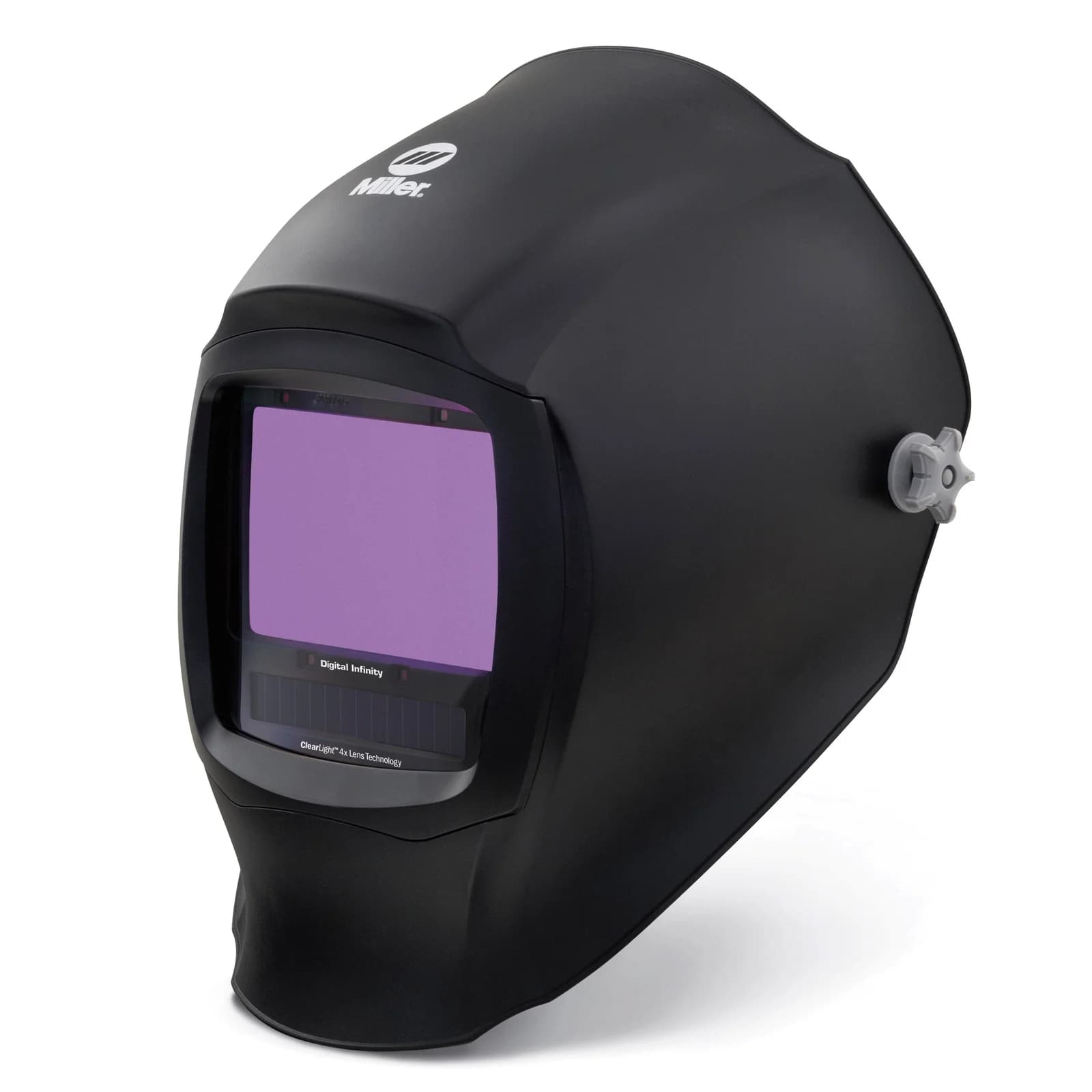
The best welding helmet is an auto-darkening helmet that reaches the shade your work needs (shade 10 to 12 covers most MIG, stick and TIG), has enough viewing area and sensors for your positions, and suits how often you weld. For occasional welding, the Miller Classic Series covers shades 8 to 12. For all-day work, step up to a larger view and a clearer light state, like the Miller Digital Infinity or an Optrel.
A welding helmet protects your eyes from arc radiation, and a good one also makes you a better welder, because you can see the joint clearly before, during and after the weld. This guide explains what shade you need for each process, the features worth paying for, and how the four helmets we stock compare.
What Shade Do You Need?
The right shade depends on the process and the amperage. OSHA sets a minimum shade, and ANSI and AWS recommend a starting shade. OSHA's rule of thumb is to start with a shade too dark to see the weld zone, then go lighter until you can see it clearly, but never below the minimum.
| Process | Arc current | OSHA minimum shade | ANSI/AWS suggested shade |
|---|---|---|---|
| MIG / flux-core | 60–160 A | 10 | 11 |
| MIG / flux-core | 160–250 A | 10 | 12 |
| Stick | 60–160 A | 8 | 10 |
| Stick | 160–250 A | 10 | 12 |
| TIG | Under 50 A | 8 | 10 |
| TIG | 50–150 A | 8 | 12 |
| Plasma cutting (light) | Under 300 A | 8 | 9 |
Features That Matter
Once a helmet covers the shades you need, these features decide how comfortable it is to use all day:
- Light state: how dark the lens is before the arc strikes. Optrel's Crystal Lens Technology reaches shade 2 with 31% light transmission, and the Miller Digital Infinity has a shade 2.5 light state, so you can fit up and check welds with the helmet down.
- Viewing area: a bigger window shows more of the joint. The Miller Classic Series has 5.15 sq in. and the Digital Infinity 13.4 sq in., the largest of any Miller helmet. The Optrel Panoramaxx CLT's curved lens widens the view further.
- Arc sensors: more sensors react better when your body or the workpiece blocks part of the arc. The Classic Series has 2, the Digital Infinity 4 and the Panoramaxx CLT 5.
- Optical clarity: rated in four categories (optical quality, light diffusion, shade consistency across the lens and angle dependence), with 1 as the best score. Miller's ClearLight 4x lens is rated 1/1/1/1.
- Power: battery/solar-assist lenses like the Classic Series never need charging; the Panoramaxx CLT uses a solar-assisted lithium-polymer pack that charges by USB.
- Weight and headgear: lighter helmets are easier on your neck over a long day. The Classic Series weighs about 16 oz.
Four Helmets Compared
These are the auto-darkening helmets we stock, from an entry-level helmet for occasional use to Optrel's widest-view model.
| Helmet | Price | Key specs | Warranty | Best for |
|---|---|---|---|---|
| Miller Classic Series | $140.00 | Shades 8–12, 5.15 sq in. view, 2 sensors, about 16 oz, battery/solar-assist | 3-year lens warranty | Occasional and light-duty welding |
| Miller Digital Infinity | $398.00 | 13.4 sq in. view, shade 2.5 light state, 4 sensors, ClearLight 4x (1/1/1/1), 4 modes | 4 years, including the lens | All-day welding and out-of-position work |
| Optrel Crystal 2.0 | $574.00 | Shade 2 light state (31% transmission), automatic shades 4–12, adjustable ±2 | 3 years with registration | Frequent fit-up and inspection between welds |
| Optrel Panoramaxx CLT | $639.00 | Curved wide-view lens, shade 2 light state, shades 5–12, 5 sensors, 610 g, rated to 280 A | 2 years, plus 1 with registration | Maximum field of view |
Do You Need a PAPR Helmet?
A powered air-purifying respirator (PAPR) blows filtered air into a sealed helmet, protecting your lungs as well as your eyes. It's worth considering if you weld for long stretches without good fume extraction. Your employer's safety program should set the requirement for your work.
The Optrel e3000X PAPR blower gives TH3 particulate protection against smoke, aerosols and dust, delivers up to 240 litres of air per minute, runs up to 18 hours, and accepts an A1B1E1 gas filter. It pairs with a compatible Optrel PAPR helmet, which is sold separately.
Protect Your Eyes Under the Helmet Too
OSHA notes that where chips, slag or grinding debris can fly, a welding helmet alone isn't enough: wear safety glasses with side shields or goggles underneath. Eye and face protection should comply with ANSI Z87.1. For the rest of your protective gear, see our guide to FR clothing standards.