Quick answer
NFPA 2112 certifies flame-resistant clothing for flash-fire hazards, such as at oil, gas and chemical sites. ASTM F1506 is the performance specification for flame-resistant, arc-rated clothing for workers exposed to flames and electric arcs. NFPA 70E is the electrical-safety standard that sets the arc rating your PPE needs for a job. One garment can meet all three.
FR clothing labels are full of standard numbers, and the three you'll see most often cover different hazards. This guide explains what NFPA 2112, ASTM F1506 and NFPA 70E each require, how arc ratings and PPE categories work, and what that means if you weld.
The Three Standards in Brief
NFPA 2112 is the standard on flame-resistant clothing for protecting industrial workers from short-duration thermal exposure from fire, meaning a flash fire. Garments are tested on an instrumented manikin and must be certified by a third party and labeled. It's the standard oil and gas, refining and chemical sites usually require.
ASTM F1506 is the performance specification for flame-resistant and electric arc rated protective clothing worn by workers exposed to flames and electric arcs. It sets minimum requirements for flame resistance, arc rating, fabric durability and garment construction, and requires the label to state the arc rating.
NFPA 70E is the standard for electrical safety in the workplace. It doesn't test garments. Instead, it tells employers how to assess arc-flash risk and what arc rating the PPE for a task must have, either from an incident-energy analysis or from its PPE category tables.
Side-by-Side Comparison
| Standard | What it covers | Who it applies to | Key requirement |
|---|---|---|---|
| NFPA 2112 | Flame-resistant garments for short-duration fire (flash fire) exposure | Oil and gas, refining, chemical and other flash-fire sites | Manikin test: 50% or less predicted body burn at a 3-second exposure; third-party certification |
| ASTM F1506 | Flame-resistant, arc-rated clothing | Workers exposed to electric arcs and flames | Fabric must have an arc rating (ATPV or EBT, in cal/cm²) shown on the label |
| NFPA 70E | Electrical safety in the workplace, including arc-flash PPE | Anyone working on or near energized electrical equipment | PPE arc rating must match the hazard (for example, CAT 2 = 8 cal/cm² minimum) |
Arc Ratings and PPE Categories
An arc rating tells you how much heat energy from an electric arc a fabric can block, in calories per square centimeter (cal/cm²). It's reported as ATPV (arc thermal performance value, the energy at which there's a 50% chance of a second-degree burn through the fabric) or as EBT (breakopen threshold energy), whichever is lower. A higher number means more protection.
NFPA 70E groups arc-flash PPE into four categories by minimum arc rating: CAT 1 at 4 cal/cm², CAT 2 at 8, CAT 3 at 25 and CAT 4 at 40. For example, the Black Stallion JF1340 hoodie is arc rated to ATPV 26 cal/cm², which meets CAT 3.
What Should Welders Wear?
None of these three standards is written for welding. For welding itself, the concern is sparks, spatter, slag and arc radiation, and the US welding safety standard, ANSI Z49.1, calls for clothing that protects against them. Flame-resistant cotton and leather are the usual choices; avoid synthetic fabrics that can melt.
If you weld on a site that requires NFPA 2112 or NFPA 70E garments, such as a refinery or near energized equipment, your FR layer must meet that standard too, and a leather welding jacket or sleeves go over it for heavy spatter. Your employer's PPE rules decide what's required.
- Light welding, or a base layer: Black Stallion FS7-KHK FR cotton shirt, 7 oz. FR-treated cotton meeting ASTM F1506.
- Warmth that won't ignite: Black Stallion JF1340 hoodie, NFPA 2112 and ASTM F1506 compliant, arc rated CAT 3.
- Heavy spatter and overhead welding: Black Stallion DuraLite pigskin welding jacket.
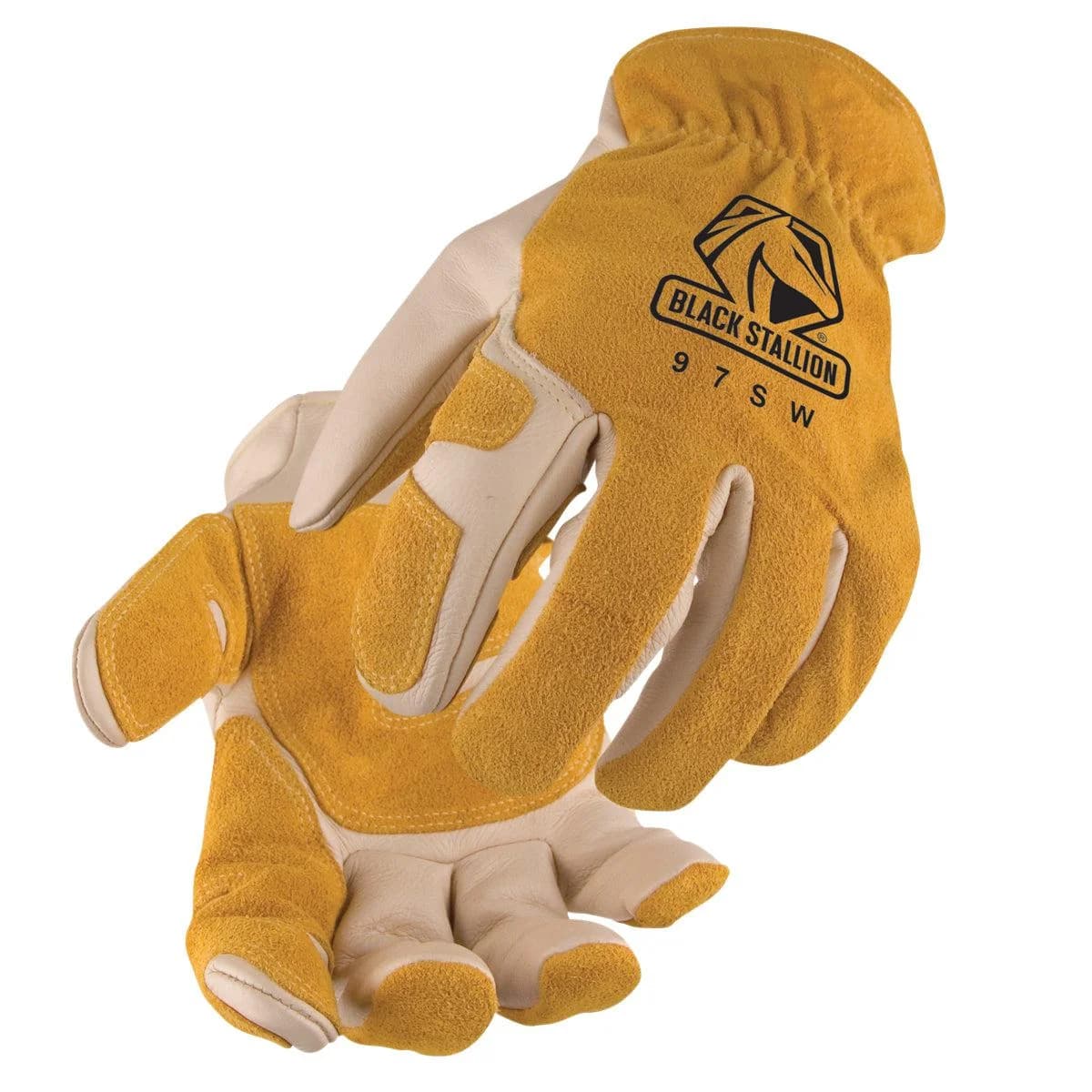
- Hands: Black Stallion 97SW cowhide gloves for spot welding and handling; a lined gauntlet glove for heavy stick work.
FR Clothing Compared
| Garment | Price | Standards | Arc rating | Rated wash life |
|---|---|---|---|---|
| Black Stallion FS7-KHK shirt | $32.99 | ASTM F1506 | Shown on garment label | 50 home / 25 commercial washes |
| Black Stallion JF1340 hoodie | $67.35 | NFPA 2112, ASTM F1506, NFPA 70E | ATPV 26 cal/cm² (CAT 3) | 100 washes |
Caring for FR Clothing
Follow the care label. Treated FR cotton is rated to keep its flame resistance for a stated number of washes, such as 50 home or 25 commercial washes for the FS7-KHK shirt, while the JF1340 hoodie is tested to keep its protection through 100 washes. Keep FR garments free of oil and grease, which can burn, and replace them when they're torn, worn thin or heavily contaminated.